
A story about the Johansen Formation
CO2 from Northern Lights is stored in the Johansen Formation, south of the Troll field. This page provides insight into the process of identifying a suitable CO2 storage site and the key milestones along the way.
Excellent reservoir quality
Norway has extensive experience with CO2 storage in geological formations. Since 1996, approximately one million tonnes of CO2 per year have been captured from the natural gas produced at the Sleipner West field in the North Sea. The CO2 is injected and stored in the Utsira Formation, a geological formation located above the gas reservoir but more than 800 metres below the seabed. The Utsira Formation is a sandstone formation with excellent reservoir quality. It forms part of the vast Utsira-Skade aquifer. The injected CO2 rises through the formation and accumulates beneath the overlying shale caprock. Gas production from the Gudrun and Utgard fields was connected to the Sleipner processing facilities in 2014 and 2019, respectively, contributing to the volumes of CO2 stored in the Utsira Formation.
CO2 Storage Site EL001
The CO2 storage site covered by Exploitation Licence 001 (EL001) is the third CO2 storage site developed in Norway. It forms part of Northern Lights (NL), the transport and storage component of Longship. It can take several years to develop a potential CO2 storage site to the point where CO2 injection can begin. The development process described here outlines all the activities undertaken prior to the submission of the Plan for Development and Operation (PDO) for the Northern Lights project. The selection of CO2 storage reservoirs for the Sleipner West and Snøhvit gas fields was driven by the development plans for those petroleum projects. The process for Northern Lights was different, as the project was not associated with the development of a field for petroleum production. The search for a suitable CO2 storage site began with an assessment of the Norwegian continental shelf in 2007. The potential storage site was subsequently evaluated and developed through several stages.
Finding a CO2 Storage Site (2005–2020)
2005-2010
2005
CLIMIT was established by the Norwegian Ministry of Petroleum and Energy (MPE) in 2005, initially to support the development of CO2 capture technologies for gas-fired power plants. In 2008, the funding scheme was expanded to include power generation from all fossil fuels, and in 2010, CO2 emissions from industrial sources were also included.
Projects funded through the CLIMIT programme have contributed to significant technological advances and the development of substantial expertise in Norway, both within research institutions and among industry partners. Several projects have helped ensure safe and efficient CO2 storage in the Johansen Formation within the EL001 licence area. The North Sea Basin Task Force was established to develop a framework for the transport, injection and permanent subsea storage of CO2 in the North Sea Basin.
2007
Gassnova was established in 2005 under the Norwegian Ministry of Petroleum and Energy (MPE). The state enterprise Gassnova SF was established in June 2007, operating under the MPE and managing the Norwegian state’s interests in CCS projects. The Norwegian Petroleum Directorate (NPD) identified potential areas suitable for storing CO2 captured from the gas-fired power plants at Kårstø and Mongstad. A report prepared for the MPE by Gassnova, Gassco AS and the NPD concluded that CO2 could be safely stored offshore Norway. The Utsira and Johansen formations on the Horda Platform emerged as the most suitable storage sites.
2008
The Norwegian Petroleum Directorate (NPD) acquired 3D seismic data south of the Troll field in the North Sea. The objective was to assess the suitability of the Lower Jurassic sandstone in the Johansen Formation for permanent CO2 storage and to propose locations for CO2 injection wells.
2008-2014
The Norwegian government funded several studies assessing the potential for CO2 storage in the Johansen Formation and in the vicinity of the giant Troll gas field. Gassnova acquired new seismic data south of the area surveyed in 2008 and east of the Troll field. Gassnova and several consultants conducted extensive studies of the Johansen Formation and the Upper Jurassic Sognefjord Formation. The studies resulted in a report published in 2012, which identified two promising areas for CO2 storage: the Smeaheia area east of the Troll field and the Johansen Formation south of the Troll field.
2010
The “One North Sea” report examined cross-border CO2 transport and storage in the North Sea. Commissioned by the North Sea Basin Task Force, the study analysed industrial CO2 emissions around the North Sea Basin and opportunities for CO2 storage (Figure 1).
The Norwegian CO2 Storage Forum was established under the leadership of the Norwegian Petroleum Directorate (NPD), bringing together representatives from academia, research institutes, oil companies and the Ministry of Petroleum and Energy (MPE).

2011-2015
2011
The Norwegian Ministry of Petroleum and Energy (MPE) invited companies to nominate areas in the North Sea and Norwegian Sea with potential reservoirs for permanent CO2 storage. Five areas were nominated, three of which were recommended by the Norwegian Petroleum Directorate (NPD) to the MPE for the first licensing round. The NPD published a CO2 Storage Atlas covering the Norwegian sector of the North Sea Basin. Its purpose was to provide an overview of geological formations and structures that could be suitable for CO2 storage. A system for characterising and maturing potential CO2 storage sites was also established.
2013
The Norwegian government set a new direction for carbon capture and storage (CCS). Plans to develop a full-scale CO2 capture facility at Mongstad were discontinued and replaced by a broader CCS programme. The government’s revised strategy included a programme aimed at realising full-scale CCS projects in Norway. Gassnova SF was commissioned to conduct a concept study exploring alternative CCS projects in Norway.
2014
The CO2 Storage Atlas for the Norwegian continental shelf, published by the Norwegian Petroleum Directorate (NPD), estimates a CO2 storage potential of more than 80 billion tonnes on the Norwegian continental shelf (Figure 2). Regulations governing the transport and storage of CO2 were published.

2015
Gassnova leverer et CCS-idéstudie til OED. Gassnova fikk deretter finansiering til en serie mulighetsstudier for CO2-håndtering, basert på resultatene fra idéstudien. OED og Statoil ASA inngikk en avtale om å utforske mulighetene for geologisk lagring av CO2 i tre ulike områder på norsk sokkel. Ulike utbyggingskonsepter skulle også utredes. Dette var en del av OEDs mulighetsstudie.

2016-2020
2016
The Norwegian Ministry of Petroleum and Energy (MPE) presented the feasibility study, which demonstrated that a full-scale carbon capture and storage (CCS) project could be realised in Norway. Gassnova delivered the study, which covered three CO2 capture facilities and one CO2 storage site as part of a new full-scale CCS project. Equinor Energy AS (Equinor) conducted the assessment of potential storage sites and recommended further studies in the Smeaheia area (Figure 3). Gassco delivered a feasibility study assessing CO2 transport from a capture facility to a storage site, involving the shipment of CO2 from Eastern Norway to Western Norway.
2016-2020
Equinor established the Northern Lights partnership with A/S Norske Shell and Total E&P Norge AS. With government funding, Northern Lights (NL) carried out concept selection and Front-End Engineering Design (FEED) studies for a new CO2 storage site. Gassnova coordinated these studies with those for the two CO2 capture facilities during the concept development phase. Northern Lights decided to relocate the storage site on the Horda Platform from the Smeaheia area east of the Troll field to the Johansen Formation south of the Troll field.

2018
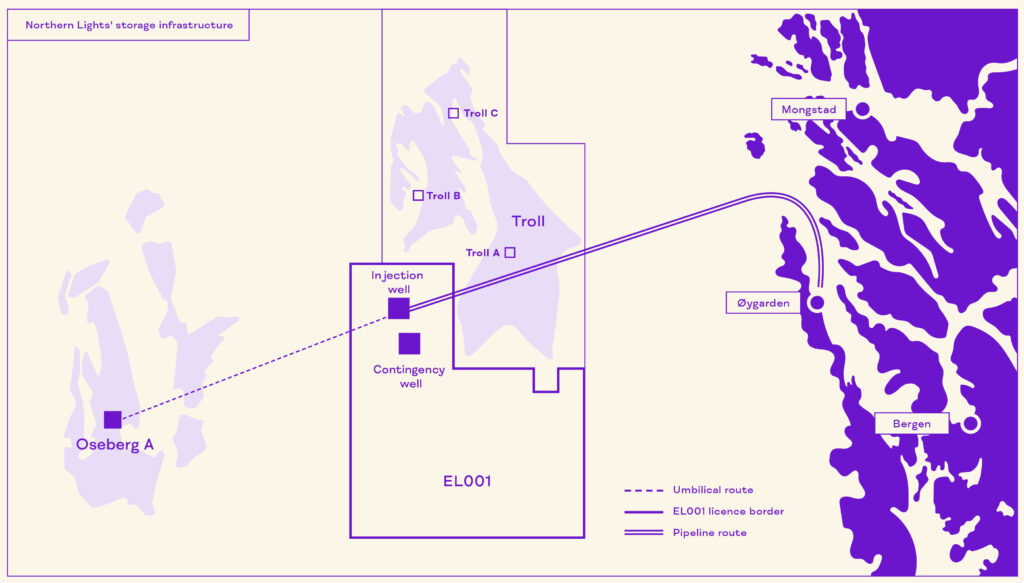
The Norwegian Ministry of Petroleum and Energy (MPE) announced the first licensing round for CO2 storage in the area south of the Troll field (Figure 4).
2019
The Norwegian Ministry of Petroleum and Energy (MPE) awarded the first CO2 storage exploitation licence, EL001, to Equinor.
2020
The first exploration well, 31/5-7 Eos, was drilled within the licence area. The well confirmed favourable geological properties for CO2 storage. Northern Lights submitted the Plan for Development and Operation (PDO) for EL001 to the Norwegian Ministry of Petroleum and Energy (MPE).