

14.04.2026
Northern Lights has unique operational experience in CO₂ management
A recent experience report from Northern Lights provides a unique insight into how a full-scale CO2 value chain operates in practice.
The experiences from Northern Lights JV (NL) also demonstrate the importance of research and technology development as the foundation for the Longship project, of which NL is a part. Longship illustrates how CLIMIT projects support the development, operation, and further maturation of the storage solution on the Norwegian continental shelf.
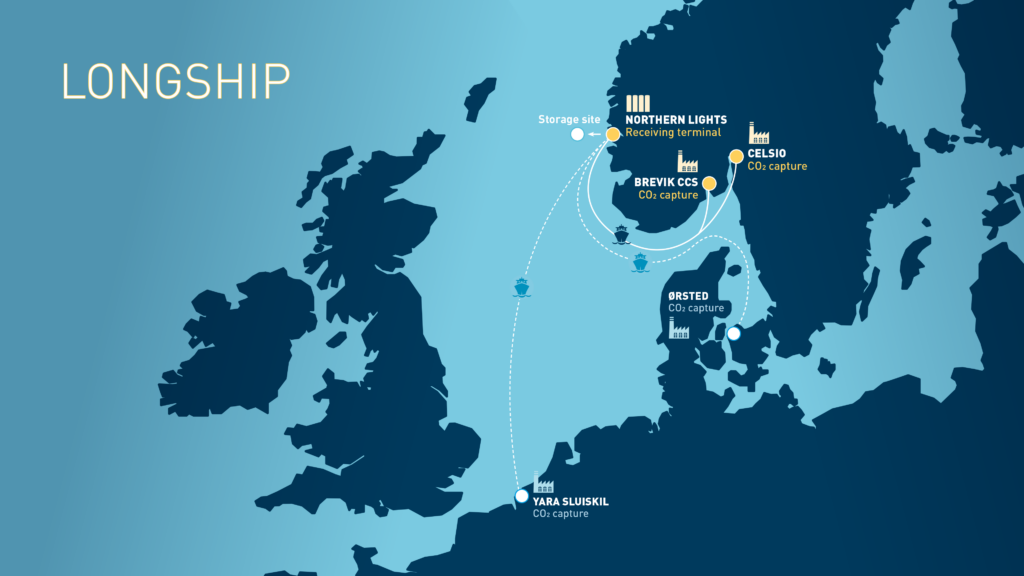
Longship
The Longship initiative enables European industry to transport CO2 for permanent storage on the Norwegian continental shelf. The experience report from NL provides a comprehensive overview of lessons learned from the establishment and start-up of the entire value chain. The report describes, among other things, operational experience with purpose-built CO2 carriers, commissioning of the onshore receiving terminal, and coordination of logistics between capture, transport, and storage.
2025 marked a major milestone for NL. The liquid CO2 transport vessels became operational, the receiving terminal in Øygarden received its first deliveries, and the complete Longship value chain was brought into operation. The experience gained from Longship provides a unique foundation for understanding how industrial CO2 value chains function at full scale.
Complex logistics in a new industry
The experience report shows that a CO2 value chain is more complex than many previous analyses have suggested. For reservoir injection to operate reliably, the entire chain – from capture to storage – must function in parallel. Variations in CO2 production affect ship loading and transport planning. Injection operations depend on a stable and continuous supply of CO2.
The experience highlights that close coordination among all actors in the value chain is essential to maintain continuous operations. This applies not only to transport and logistics, but also to monitoring of the storage area, an area where several CLIMIT projects play a direct role in strengthening NL’s operational robustness.
The CLIMIT programme
To document that CO2 is stored safely and permanently, operators must be able to track reservoir behaviour over time. This requires advanced monitoring systems capable of detecting even minor changes in the subsurface.
Several CLIMIT-supported projects have been developed for application areas represented by NL. A key example is the H-Net-3 project, where Equinor, together with partners, is establishing and further developing a regional seismic monitoring network for the Horda Platform, storage site for NL. The project aims to enable continuous measurement of background seismicity, so that changes related to CO2 injection can be identified and understood in real time.
In parallel, new technologies are being developed through projects such as DAS4HNET, where fibre-optic cables are used as sensors to detect microseismic events near the injection area. The project involves a broad industry consortium, including NL, and aims to improve both the detection and localisation of seismic events, as well as to integrate data into operational decision-making systems.
These projects illustrate how research activities are not generic, but closely linked to NL’s areas of operation – from baseline establishment prior to injection to continuous monitoring during operations.
Interaction between research and operations
Experience from NL demonstrates how research and industrial operations mutually reinforce each other. Full-scale operations provide insight into practical challenges and operational conditions, while research projects develop technologies that can reduce risk and improve monitoring.
In seismic monitoring in particular, the connection between the projects and NL is evident: H-Net-3 establishes the reference baseline for natural seismicity, while DAS4HNET develops next-generation measurement methods for continuous and more precise monitoring of the storage site. Together, this provides a more comprehensive understanding of how the subsurface responds to CO2 injection.
Senior Advisor Technology at Gassnova, Jale Mutlu, considers this interaction essential for the development of CO2 storage.
“Experience from Northern Lights provides valuable insight into how a CO2 value chain operates in practice. At the same time, new monitoring technologies are being developed through CLIMIT that can strengthen our understanding of what happens in the subsurface, and make storage even better documented.”
Jale Mutlu, Senior Advisor Technology at GassnovaA foundation for the next generation of CO2 storage
The Longship project provides experience that cannot be obtained through simulations alone. At the same time, research provides a critical knowledge base for further technological development.
Development of projects such as H-Net-3 and DAS4HNET demonstrates how the CLIMIT portfolio functions in practice as an operational technological support system. Operational experience identifies needs, while projects develop solutions that can be rapidly tested and implemented within the same value chain.
This close linkage between operations and technology development helps reduce uncertainty, strengthen documentation of storage integrity, and lay the groundwork for scaling CO2 storage across Europe. – When experience from Northern Lights is combined with technology development through CLIMIT, we gain an increasingly robust knowledge base for how CO2 can be stored safely and cost-effectively in future projects, says Jale Mutlu at Gassnova.