
07.01.2026
Achieved Benefits of the Longship Initiative
Longship is now operational as a full-scale value chain for CO2 management. What does market development tell us about the benefits delivered by Longship to date?
On assignment from Gassnova, which coordinates Longship’s benefits realisation work, DNV has conducted an independent assessment of benefit achievement through the end of 2025.
Longship is Norway’s full-scale demonstration project for carbon capture and storage (CCS). The project is now in operation, with CO2 captured at Heidelberg Materials’ cement plant in Brevik, transported to Øygarden, and injected into the Northern Lights storage reservoir in the North Sea. Hafslund Celsio’s Oslo CCS project is in the construction phase, with expected start-up in 2029. Longship also financed a flexible transport and storage solution with some excess capacity (Northern Lights Phase 1).
– We are pleased that DNV finds that the realisation of Longship represents a breakthrough for CO2 management in Europe, and that many of the benefits society seeks from the project have developed positively over the past year. Going forward, we will see how Longship can share operational experience from the project with key stakeholders, says Aslak Viumdal, Senior Adviser at Gassnova.
Development of the Demonstration Effect
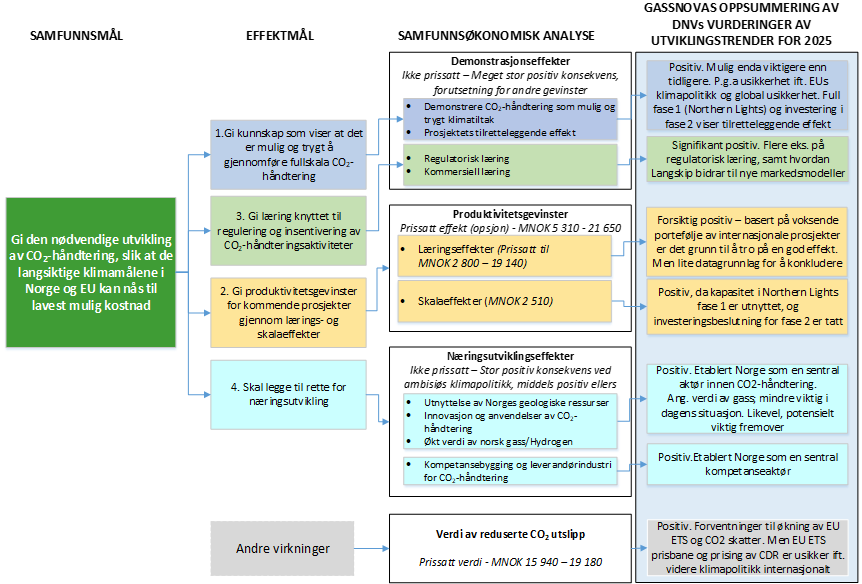
DNV concludes that the demonstration effect has strengthened since the previous status update. Northern Lights Phase 1 is operational and fully booked, and the investment decision for Phase 2 has been taken. Phases 1 and 2 include commercial agreements for substantial CO2 volumes from actors in Denmark, the Netherlands, and Sweden.
Oslo CCS has progressed following Hafslund Celsio’s new investment decision in January 2025. Taken together, this demonstrates that a full-scale CCS value chain is technically feasible and in demand. DNV’s report also notes that Longship has contributed to regulatory and commercial learning, and that the project is being used as a reference in the development of new CCS projects across Europe.
Learning Effects and Cost Development
With respect to cost-reduction effects, DNV assesses development as positive, though still difficult to quantify. Experience from Brevik CCS and Northern Lights indicates learning effects related, among other things, to CO2 transport, standardisation of CO2 quality, and optimisation of solutions across the value chain.
The investment decision for Northern Lights Phase 2 is considered to strengthen the potential for economies of scale. While specific unit costs have not been disclosed, the growing project portfolio provides a basis for productivity gains over time.
Industrial Development and Storage Capacity in Norway
DNV’s report assesses the overall industrial development effect as positive. The number of storage licences on the Norwegian continental shelf has increased, and Norway has entered into several bilateral agreements on cross-border transport and storage of CO2. This strengthens the country’s potential as a storage destination in a European CO2 management market, although reported challenges among operators on the Norwegian continental shelf.
The DNV report further highlights Longship’s contribution to the development of new business models, including low-emission cement and carbon credits from waste incineration. At the same time, it notes that some areas – such as blue hydrogen and domestic demand for CO2 capture – remain limited in development.
The Value of CO2 Management
The value of captured and stored CO2 is assessed as higher than in the previous status report. This is linked to expectations of rising carbon prices and increasing abatement costs for alternative emission-reduction measures. Although capture volumes from Oslo CCS have been somewhat revised downward, the overall effect of stored CO2 is still considered positive.
DNV’s report also identifies untapped potential for additional benefits from Longship. Gassnova will consider these further, potentially in dialogue with the industrial partners in Longship and other stakeholders.
Status of benefit realization for Longship 2025
The DNV report can be read here (Norwegian).
Photo: DNV